The Organism That Turned Sugar Into Civilization | Saccharomyces cerevisiae
The organism that makes your bread, beer, and wine also changed biology forever. Saccharomyces cerevisiae has accompanied humanity for thousands of years, although for most of that time we did not know it existed. This video explores its history from ancient Egypt to Pasteur's...
20 resources
- 1. History and Taxonomy
- [EN] Lahue, C., Madden, A. A., Dunn, R. R., & Smukowski Heil, C. (2020). History and domestication of Saccharomyces cerevisiae in bread baking. Frontiers in Genetics, 11, 584718.pdf PDF
- [EN] Pontes, A., Hutzler, M., Brito, P. H., & Sampaio, J. P. (2020). Revisiting the taxonomic synonyms and populations of Saccharomyces cerevisiae—Phylogeny, phenotypes, ecology and domestication. Microorganisms, 8(6), 903.pdf PDF
- [EN] U.S. Environmental Protection Agency. (1997, February). Final risk assessment of Saccharomyces cerevisiae External link
- [ES] Arias Ochoa, A. (2020). Identificación morfológica, fisiológica y molecular de levaduras del género Saccharomyces para la elaboración de cerveza. Mente Joven, 20(2), 55-64 External link
- [ES] Jiménez-Cid, V. J. (2021). Evolución de Saccharomyces cerevisiae, el mejor amigo del hombre. Asociación Española de Técnicos de Cerveza y Malta External link
- 2. Physiology and Metabolism
- [EN] Dickinson, J. R., & Schweizer, M. (Eds.). (2004). The metabolism and molecular physiology of Saccharomyces cerevisiae (2nd ed.). CRC Press External link
- [EN] Leupold, S., Tkach, J. M., & Yvert, G. (2019). Saccharomyces cerevisiae goes through distinct metabolic phases during its replicative lifespan. eLife, 8, e41046.pdf PDF
- [EN] Soares, E. V., & Mota, M. (2011). Flocculation in Saccharomyces cerevisiae: A review. Journal of Applied Microbiology, 110(1), 1-18 External link
- [ES] De Martín Barry, A. M. (2005). Control del metabolismo de Saccharomyces cerevisiae en la síntesis de glutatión [Tesis doctoral, Universidad de Granada] External link
- [ES] Suárez-Machín, C., Egusquiza-Ramírez, A., Calaña-Anaya, F., & Pérez-Gálvez, C. (2016). Levadura Saccharomyces cerevisiae y la producción de alcohol: Revisión bibliográfica. ICIDCA, 50(4), 3-16 External link
- 3. Genetics and Evolution
- [EN] Bai, F.-Y., Han, D.-Y., Duan, S.-F., & Wang, Q.-M. (2022). The ecology and evolution of the baker’s yeast Saccharomyces cerevisiae. Genes, 13(2), 230.pdf PDF
- [EN] Cromie, G. A. (2013). Genomic sequence diversity and population structure of Saccharomyces cerevisiae assessed by RAD-seq. G3 Genes Genomes Genetics, 3(12), 2163-2171.pdf PDF
- [EN] Engel, S. R., Dietrich, F. S., Fisk, D. G., Binkley, G., & Cherry, J. M. (2014). The reference genome sequence of Saccharomyces cerevisiae: Then and now. G3 Genes Genomes Genetics, 4(3), 389-398.pdf PDF
- [ES] Méndez, B. S. (2014). Saccharomyces cerevisiae es un buen(a) amiga. Química Viva, 13(2), 1-4 External link
- 4. Industrial and Medical Applications
- [EN] Ostergaard, S., Olsson, L., & Nielsen, J. (2000). Metabolic engineering of Saccharomyces cerevisiae. Microbiology and Molecular Biology Reviews, 64(1), 34-50 External link
- [EN] Parapouli, M., Vasileiadis, A., Afendra, A. S., & Hatziloukas, E. (2020). Saccharomyces cerevisiae and its industrial applications. AIMS Microbiology, 6(1), 1-31.pdf PDF
- [EN] Que, Z., Wang, S., Wei, M., Fang, Y., Ma, T., Wang, X., & Sun, X. (2024). The powerful function of Saccharomyces cerevisiae in food science and other fields: A critical review. Food Innovation and Advances, 3(3), 167-180.pdf PDF
- [ES] Ciklic, I., & Cuello, R. (2020). La biotecnología de levaduras como herramienta para la industria de bebidas alcohólicas. INTA External link
- [ES] Moreno-Rivas, S. C., & Ramos-Clamont Montfort, G. (2018). Descontaminación de arsénico, cadmio y plomo en agua por biosorción con Saccharomyces cerevisiae. TIP Revista Especializada en Ciencias Químico-Biológicas, 21, 51-68 External link
- licencias.json JSON
Transcript
Introduction
0:00Hi everyone! Welcome to this video, where we're going to dive into the fascinating world of Saccharomyces cerevisiae. Yes, that mouthful of a name is just a fancy way of saying yeast, the tiny organism that makes our bread rise and our drinks more fun. Today we're going to explore its history, characteristics, industrial applications, metabolism, and much more. Let's get started!
History of yeast
0:23The history of Saccharomyces cerevisiae goes back thousands of years. Picture the ancient Egyptians enjoying good bread and a fresh beer thanks to this little friend. They had no idea what was really going on, but they knew that something magical in the air made their bread fluffy and their drinks ferment.
0:43The Egyptians even had gods associated with fermentation, such as Osiris, and used yeast in their religious rituals. Fermentation was seen as a kind of alchemy. Let's fast-forward a few thousand years to the 17th century, when the microscope was invented. Anton van Leeuwenhoek, or however you want to pronounce it, is now known as the father of microbiology, and was one of the first to observe yeast under the microscope, although he didn't understand its role in fermentation.
1:12Then, in the 19th century, the great Louis Pasteur, the same guy who gave us pasteurization, set out to investigate seriously. Pasteur showed that yeast was responsible for fermentation, solving the mystery that had puzzled bakers and brewers for centuries. Thank you very much, oh mighty Louis.
1:32Pasteur also showed that these processes weren't simply spontaneous chemical reactions, but were caused by living microorganisms, a revolutionary discovery for microbiology. This led to the development of techniques to control and improve fermentation, greatly benefiting the food and beverage industries.
Taxonomic classification and morphology
1:53Saccharomyces cerevisiae belongs to the kingdom Fungi, the phylum Ascomycota, the class Saccharomycetes, the order Saccharomycetales, and the family Saccharomycetaceae. It has an oval shape and can grow on a variety of media, fermenting sugars to produce alcohol and carbon dioxide. We'll get to that later.
Cell structure
2:14Saccharomyces cerevisiae is a unicellular fungus with a fairly complex cell structure for its size. Like all eukaryotes, it has a well-defined nucleus that contains its DNA. It also has organelles such as mitochondria, which are essential for energy production, and endoplasmic reticulum, of course, which plays an important role in protein synthesis.
2:35The cell wall of Saccharomyces cerevisiae is quite robust and is made up mainly of glucans and mannoproteins, which give it strength and shape. This cell wall also plays a key role in protecting against osmotic stress and other adverse environmental factors. Another interesting feature is its ability to form spores under unfavorable conditions, allowing it to survive until conditions improve.
3:00During budding, the mother cell produces a small protrusion, or bud, which eventually becomes a fully functional daughter cell. It's like a miniature clone, ready to take over. Saccharomyces cerevisiae also has vacuoles, organelles responsible for storing nutrients and waste products, as well as maintaining osmotic balance within the cell.
3:24These vacuoles are essential for the cell's survival under stress conditions. The presence of peroxisomes in Saccharomyces cerevisiae is also notable; these are organelles involved in the detoxification of peroxides. These organelles play a crucial role in lipid metabolism and in the response to environmental changes. It's known that there can be no metabolism without transport first.
Glucose transport
3:47It's like trying to eat a delicious cake fermented with Saccharomyces cerevisiae that's sitting outside your house. In the case of Saccharomyces cerevisiae, glucose has to be transported into the cell before it can be metabolized. Glucose enters the cytoplasm of Saccharomyces cerevisiae through a process called facilitated transport.
4:07This type of transport uses specific transporter proteins in the cell membrane to move glucose from outside to inside the cell. These transporter proteins, known as glucose transporters or GLUTs, bind to glucose molecules and shuttle them across the cell membrane through a mechanism of facilitated diffusion.
4:30This process doesn't require energy in the form of ATP, since glucose moves along its concentration gradient, that is, from where there's more glucose to where there's less. Glucose transport is essential for Saccharomyces cerevisiae to carry out its metabolic functions, including fermentation and cellular respiration. Without efficient glucose transport, the cell couldn't obtain the energy it needs to survive and thrive.
Alcoholic fermentation
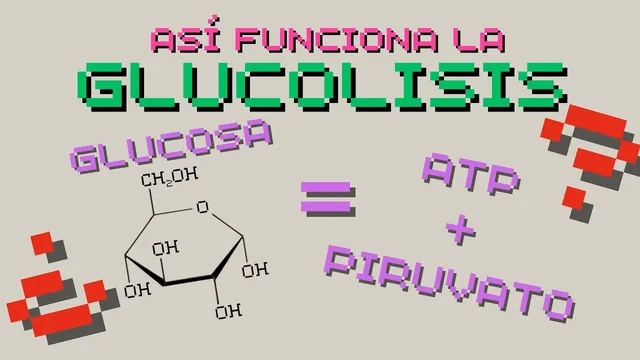
4:56Now let's talk about the star of the show, alcoholic fermentation. Saccharomyces cerevisiae converts sugars into ethanol and carbon dioxide. How does it do it? Let's find out. It all starts with glycolysis, where one molecule of glucose is broken down into two molecules of pyruvate, producing a net gain of two molecules of ATP and two molecules of reduced NAD.
5:18Under anaerobic conditions, pyruvate is converted into ethanol and CO2 in two steps. First, pyruvate is decarboxylated to acetaldehyde by the enzyme pyruvate decarboxylase, releasing CO2. Yes, that fizz in your beer is thanks to this. Then, acetaldehyde is reduced to ethanol by alcohol dehydrogenase, regenerating oxidized NAD from reduced NAD.
5:40And there you have it! Now we have ethanol. Optimal conditions for fermentation include a temperature of around 30 °C and a neutral pH. Sugar concentration is also crucial. Too much sugar can cause a negative osmotic effect on the yeast, while too little sugar can limit ethanol production. Saccharomyces cerevisiae can tolerate alcohol concentrations of up to 18%, which is quite high compared to other microorganisms.
6:07It's like a superhero of fermentation! Different strains can produce different flavor and aroma profiles, which is put to use in the wine and beer industries to create products with unique characteristics. The electron transport chain in Saccharomyces cerevisiae is a crucial process in cellular respiration. Under aerobic conditions, this yeast uses oxygen as the final electron acceptor to generate ATP, the cell's energy molecule.
Electron transport chain
6:34The process begins with the oxidation of reduced NAD and reduced FAD, which transfer electrons to the transport chain in the inner mitochondrial membrane. The electrons pass through a series of enzyme complexes, including complex I, NADH dehydrogenase, complex II, succinate dehydrogenase, complex III, cytochrome bc1, and complex IV, cytochrome c oxidase.
6:57Let's go into more detail about the enzyme complexes involved in this process. Complex I, also known as NADH dehydrogenase, is the first step in the chain. It receives electrons from reduced NAD and transfers them to ubiquinone, while pumping protons into the intermembrane space, contributing to the proton gradient.
7:17Complex II, or succinate dehydrogenase, takes part in the Krebs cycle and also transfers electrons to ubiquinone, but doesn't pump protons, which makes it a bit less efficient at generating proton gradients. Complex III, known as cytochrome bc1, receives electrons from ubiquinone and transfers them to cytochrome c, pumping protons in the process and helping maintain the proton gradient.
7:40Finally, complex IV, or cytochrome c oxidase, transfers electrons from cytochrome c to oxygen, the final electron acceptor, to form water. This complex also pumps protons into the intermembrane space, completing the process of generating the proton gradient. This proton gradient is essential for ATP synthesis. ATP synthase uses the energy of the gradient to convert ADP and inorganic phosphate into ATP, providing energy for the yeast's cellular functions.
Genomics and its role as a model organism
8:09This process is known as chemiosmosis and is fundamental to cellular respiration. Saccharomyces cerevisiae was the first eukaryotic organism to have its genome fully sequenced, in 1996. Its genome consists of approximately 12 million base pairs and around 6,000 genes. It's a model organism in genetic studies due to its ease of manipulation and rapid reproduction.
Ten facts in one minute
8:34Now let's go through 10 fun facts in a minute, starting now. Saccharomyces cerevisiae can thrive in environments with high sugar content, such as musts and doughs. It's used in the production of various alcoholic beverages, such as beer, wine, cider, mead, rum, whisky, and sake. It's able to withstand moderate alcohol levels, allowing it to survive during alcoholic fermentation.
9:00It can produce a variety of aromas and flavors during fermentation, affecting the sensory profile of foods and beverages. This microorganism is also used in biofuel production. The name cerevisiae comes from the Latin word for beer. It's used as a model in genetic research due to its simplicity and similarities to human cells.
9:20It's a facultative anaerobe, meaning it can live with or without oxygen. It has applications in the production of medicines, such as insulin and certain vaccines. Saccharomyces cerevisiae can be genetically modified to produce human proteins, which is useful in medical and biotechnological research. And time's up.
9:40I hope you enjoyed learning about Saccharomyces cerevisiae, from its history to its modern applications. It's clear that this microorganism remains vital to many industries and fields of research. Thanks for watching the video.
More videos
Does DNA Replicate Itself?!
Did You Know All Life Is Based on This Diagram?